Praviceler: The Ultimate Guide to Real Celery, Celeriac, and Everyday Wellness
Introduction: Why “Pravi Celer” Deserves a Second Look
Celery has an image problem. For decades it was the sad stick beside the diet plate, or the crunchy garnish nobody finished. More recently, it was hijacked by the wellness-influencer economy, where a glass of green juice was promised to cure everything from acne to autoimmune disease.
Neither version is the real story.
In the Balkans and across Central Europe, celer has never been a diet food or a trend. It is the quiet backbone of the kitchen: the root that sweetens a winter soup, the leaves scattered over a pot of beans, the stalk that gives a stock its depth. Pravi celer, “real celery,” is about using this vegetable properly: choosing it well, understanding its forms, cooking it with intention, and being honest about what it can and cannot do for your health.
That is the philosophy behind praviceler, and this guide is its full expression. You will learn:
- What celery actually is, and why the word means different things in different kitchens
- What the nutrition science supports, and which popular claims it doesn’t
- A practical, step-by-step framework for building celery into your week
- Cooking techniques, storage methods, and flavor pairings that make it taste exceptional
- Who should be careful with celery, and why
- Answers to the most common questions people ask
Understanding Celery, the Plant Behind the Word
What Does “Celer” Actually Mean?
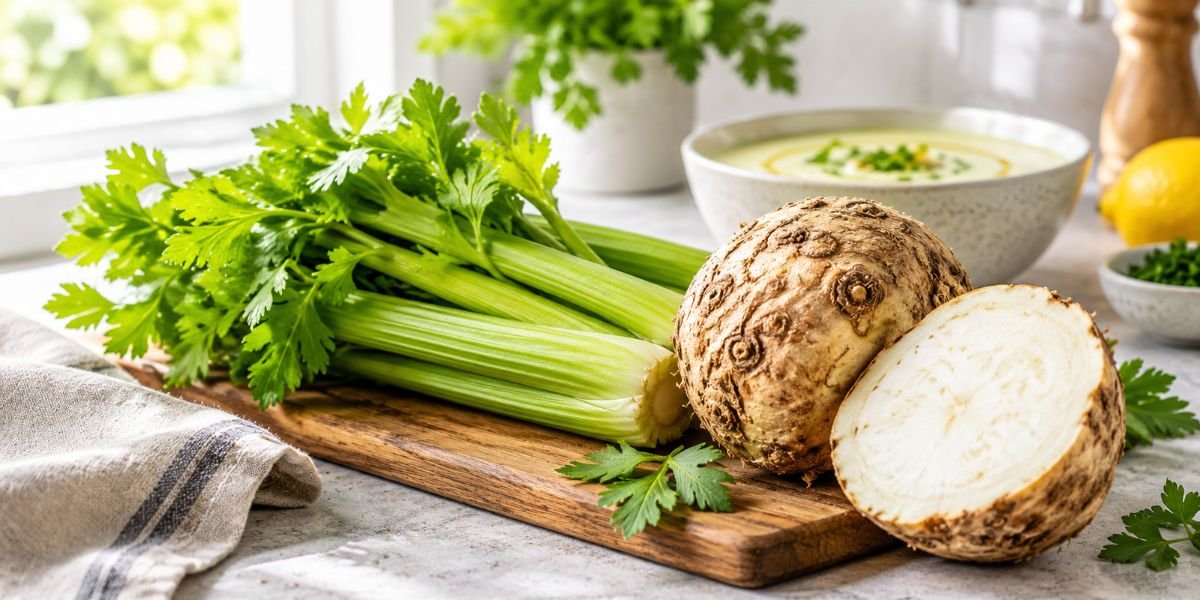
Here is where most English-language content goes wrong. In English, “celery” usually means the pale green stalks sold in bunches. In Serbian, Croatian, Bosnian, and several neighboring languages, celer most often means celeriac, the knobby, gnarled root vegetable. Stalk celery is typically specified separately, and the leaves have their own role in cooking.
All three come from one species, Apium graveolens, bred over centuries toward different parts of the plant. Knowing the difference changes how you shop and cook.
The Three Forms of Celery
1. Celeriac (Celery Root)
Botanical variety: Apium graveolens var. rapaceum
Celeriac is grown for its swollen base, which looks like a rough, beige-brown softball. Under the skin, the flesh is creamy white with a flavor that is nutty, savory, and lightly herbal.
- Best for: soups, purées, roasting, gratins, remoulade, stews
- Season: autumn through early spring
- Texture: firm when raw, silky when cooked
2. Stalk Celery (Pascal Celery)
Botanical variety: Apium graveolens var. dulce
This is the crisp, ribbed celery found in supermarkets worldwide. It is mild, watery, and slightly bitter at the outer edges, and it is the form most associated with crunchy snacks and mirepoix.
- Best for: raw eating, salads, soup bases, braises, stir-fries
- Season: available year-round, best in cooler months
- Texture: crisp and juicy
3. Celery Leaf and Cutting Celery
Botanical variety: Apium graveolens var. secalinum
Thin stalks and abundant, intensely aromatic leaves characterize this type. It is the closest to the wild ancestor, and the flavor is far stronger than that of supermarket stalks. Many cooks consider it the most underrated herb in the kitchen.
- Best for: finishing soups, herb blends, stocks, salads, sauces
- Season: spring through autumn, easy to grow at home
- Texture: tender and leafy
Quick Comparison: Which Celery Should You Use?
| Feature | Celeriac | Stalk Celery | Celery Leaf |
|---|---|---|---|
| Main flavor | Nutty, earthy, sweet | Fresh, mild, slightly salty | Intense, herbal, peppery |
| Best raw? | Grated or shaved | Yes, excellent | Yes, as an herb |
| Best cooked? | Roasted, puréed, simmered | Braised, sautéed, in stock | Added at the end |
| Calories (per 100 g) | About 40 | About 14 | About 15–25 (varies) |
| Storage life | 3–4 weeks in the fridge | 4–5 weeks | Several days |
| Role in the kitchen | Main ingredient | Flavor base or snack | Garnish and seasoning |
A well-run kitchen uses all three. That is the first principle of praviceler: don’t treat celery as one ingredient.
The Nutrition Profile, Without the Hype
What You Actually Get
Celery stalks are roughly 95% water, which is why they are so low in calories (about 14 kcal per 100 grams). Celeriac is denser and starchier, with more energy and more minerals per bite. Both are useful.
Stalk celery (per 100 g, approximate):
- Fiber: about 1.6 g
- Vitamin K: roughly a quarter of the daily value
- Potassium: about 260 mg
- Folate, vitamin C, and small amounts of calcium and magnesium
Celeriac (per 100 g, approximate):
- Calories: about 40
- Fiber: about 1.8 g
- Vitamin K: a generous share of daily needs
- Potassium: about 300 mg
- Phosphorus, vitamin C, and B-vitamins in modest amounts
Exact values vary by variety, growing conditions, and the database used. Treat them as ranges, not precise promises.
The Plant Compounds Worth Knowing
Beyond vitamins and minerals, celery contains bioactive compounds studied by food scientists:
- Apigenin and luteolin: flavonoids found in celery and especially in celery seed and leaf. They are studied for antioxidant and anti-inflammatory activity.
- Phthalides: aromatic compounds responsible for celery’s distinctive smell. Some, such as 3-n-butylphthalide, have been studied in animal models for effects on blood vessel relaxation.
- Dietary nitrates: naturally present in celery and other vegetables. In the body they can be converted into nitric oxide, which plays a role in vascular function.
- Polyacetylenes and coumarins: present in smaller amounts, with ongoing research interest.
An Honest Note on Evidence
Much of the promising research on these compounds comes from laboratory studies, animal experiments, or small human trials, often using concentrated extracts rather than a few stalks on a plate. That does not make celery unimportant, but it does mean you should be wary of anyone who claims it treats a disease.
A more defensible statement is this: celery is a nutrient-dense, low-calorie vegetable that fits well into dietary patterns consistently linked with better health, namely diets rich in vegetables, fiber, and potassium and low in ultra-processed food.
Evidence-Based Benefits of Eating Celery
1. Supports Hydration and Satiety
With such high water content and a good amount of structural fiber, celery adds volume to meals for very few calories. Crunchy, water-rich vegetables slow down eating and make a plate feel more substantial. This is genuinely useful for anyone managing portion sizes, though celery alone is not a weight-loss tool.
2. Contributes to Healthy Blood Pressure Patterns
Celery provides potassium and contains compounds like phthalides and nitrates that are of research interest for vascular health. Diets rich in potassium from vegetables and fruits are associated with healthier blood pressure, particularly when sodium intake is moderate. Celery supports that pattern; it does not replace medication or medical advice.
3. Delivers Vitamin K for Bone and Blood Health
Vitamin K contributes to normal blood clotting and plays a role in bone metabolism. Both celeriac and celery leaf are meaningful sources. (If you take warfarin, see the safety section below, because consistency matters.)
4. Provides Fiber for Digestive Health
Celery’s fiber supports regular digestion and feeds beneficial gut bacteria. Celeriac, with its slightly higher fiber density and starch content, can be especially satisfying as a potato alternative.
5. Adds Antioxidant Variety
Flavonoids like apigenin and luteolin are part of the broad family of plant compounds that make a varied, vegetable-rich diet beneficial. The practical takeaway: eating different plants, including celery’s many forms, broadens your intake of protective compounds.
6. Makes Healthy Cooking Taste Better
This benefit is underrated. Celery contributes savory depth, called umami, particularly when cooked slowly with onion and carrot. When vegetables taste good, you eat more of them. That behavior shift may be celery’s biggest real-world health contribution.
Celery Juice, Separating Fact From Fiction
No guide to celery is complete without addressing the juice trend.
What the Claims Say
Social media popularized the idea that drinking celery juice on an empty stomach can “detox” the body, heal chronic illness, or reverse autoimmune conditions.
What the Evidence Says
- No high-quality clinical evidence supports these claims. The body’s detoxification is handled by the liver, kidneys, and other organs, not by a specific juice.
- Juicing removes most of the fiber, which is one of celery’s most useful features.
- Celery juice can contribute hydration and some potassium and vitamins, and some people simply enjoy it.
- Concentrated celery juice may be high in naturally occurring nitrates and sodium, which matters for some individuals.
The Praviceler Position
Enjoy celery juice if you like it, but don’t expect miracles. Whole celery, eaten regularly, delivers more of what matters (fiber and variety) with none of the exaggerated promises. If you do juice it, consider blending instead to keep the fiber, and pair it with a balanced diet.
The Praviceler Framework, A Step-by-Step Method
Here is the practical system at the heart of this guide. It has five steps and takes minimal effort.
Step 1: Buy for Quality
Celeriac:
- Choose roots that feel heavy for their size and firm all over.
- Avoid soft spots, deep cracks, or a spongy, lightweight feel (a sign of woody, hollow centers).
- Medium-sized roots (about the size of a grapefruit) tend to be sweeter and less woody than very large ones.
Stalk celery:
- Look for tight, rigid bunches with glossy, unblemished stalks.
- A fresh stalk should snap cleanly when bent.
- Leaves, if attached, should be bright, not yellow or wilted.
Celery leaf:
- Buy it in bunches with fragrant, deep-green leaves.
- If you have a sunny windowsill or garden, grow it yourself. Cutting celery is forgiving and productive.
Step 2: Store for Longevity
| Form | Best Storage Method | Expected Life |
|---|---|---|
| Celeriac | Unwashed, in the crisper drawer or wrapped loosely in a cloth or paper | 3–4 weeks |
| Stalk celery | Wrapped loosely in foil, or upright in a jar with an inch of water, covered | 2–3 weeks |
| Celery leaf | Stems in a glass of water like flowers, or wrapped in a damp paper towel in a container | 4–7 days |
| Cut celeriac | Submerged in water with a splash of lemon juice, refrigerated | 2–3 days |
Pro tip: Revive limp stalks by trimming the base and standing them in cold water for an hour. They will crisp up noticeably.
Step 3: Prep Properly
Celeriac:
- Scrub off soil under running water.
- Slice a thin layer off the top and bottom for stability.
- Use a sharp knife (not a peeler) to cut away the thick skin and any fibrous layer beneath.
- Cut into your desired shape and place in lemon water immediately to prevent browning.
Stalk celery:
- Separate stalks and rinse thoroughly. Soil collects at the base.
- If the outer stalks are tough and stringy, peel the surface strings with a vegetable peeler.
- Reserve the leaves and the pale inner heart for other uses.
Celery leaf:
- Rinse gently and spin or pat dry.
- Chop just before using to preserve aroma.
Step 4: Cook With Intention
The cooking method should match the form. This is where most home cooks unlock the real flavor.
Roasting Celeriac
Roasting transforms celeriac from earthy to caramelized and sweet.
- Cut into 2 cm (¾ inch) cubes or thick wedges.
- Toss with olive oil, salt, and pepper.
- Roast at about 200°C (400°F) for 30–40 minutes, turning once, until golden at the edges.
- Finish with lemon zest and chopped celery leaf.
Creamy Celeriac Soup
- Sweat diced onion and leek in olive oil or butter.
- Add cubed celeriac, a potato, and enough stock to cover.
- Simmer until completely tender, about 20–25 minutes.
- Blend until smooth, season, and finish with a drizzle of good oil and fresh leaf.
Celeriac Remoulade (Raw)
- Grate celeriac on a coarse grater and toss immediately in lemon juice.
- Dress with yogurt or a little mayonnaise, mustard, salt, and herbs.
- Let it rest 20 minutes. It improves as it sits.
Braised Stalk Celery
- Cut stalks into 8 cm (3 inch) lengths.
- Brown lightly in a pan, then add stock, a bay leaf, and a splash of white wine.
- Cover and cook gently until tender and glossy, about 25 minutes.
- Serve as a side or with grains and legumes.
The Classic Flavor Base
Slowly cook diced celery, onion, and carrot in olive oil until soft and sweet. This is the foundation of countless soups, stews, sauces, and beans. Cooking it for 10–15 minutes rather than 3 builds dramatically deeper flavor.
Celery Leaf as a Finishing Herb
Stir chopped leaves into soups, bean dishes, eggs, potato salad, grain bowls, or homemade salsas. Treat them like parsley, but with a stronger, more savory edge.
Step 5: Build the Habit
Consistency beats intensity. Here is a simple weekly rhythm:
- Two soup or stew nights: use celery stalk and leaf in the base.
- One roasted celeriac side: swap it for potatoes.
- Raw celery as a snack: pair with hummus, nut butter, or a yogurt-herb dip.
- One raw salad: celeriac remoulade or celery-apple-walnut salad.
- Leaf on everything: make it your default finishing herb.
That is five touchpoints a week with almost no extra effort.
Flavor Pairings and Combinations
Celery’s best quality is that it harmonizes with so many ingredients. Use these pairings as a cheat sheet.
With celeriac:
- Apple, pear, and lemon for brightness
- Hazelnuts, walnuts, and brown butter for richness
- Thyme, bay leaf, and parsley for earthy depth
- Potato, parsnip, and leek for smooth, comforting soups
- Mustard, yogurt, and horseradish for sharp salads
With stalk celery:
- Walnuts, apples, and grapes in fresh salads
- Tomato, onion, and garlic in braises and sauces
- Chickpeas and white beans in hearty soups
- Fennel, radish, and cucumber for crunchy salads
- Anchovy, capers, and olives for Mediterranean-style relishes
With celery leaf:
- Eggs, fish, and chicken
- Lemon and olive oil in simple dressings
- Potatoes and grains
- Pickles and brines, where it adds aromatic depth
Advanced Strategies and Expert Tips
Once you have mastered the basics, these techniques will elevate your results.
1. Make Celery Salt at Home
Dry celery leaves in a low oven (about 70°C/160°F) until crisp, then crush and mix with flaky salt. It is a vastly superior seasoning to store-bought versions, and it uses leaves that would otherwise be discarded.
2. Build a Celery-Forward Stock
Simmer celery trimmings, leaves, onion skins, carrot ends, peppercorns, and a bay leaf for an hour. Strain and freeze in portions. It costs nearly nothing and tastes better than most commercial stock.
3. Use the Whole Plant
Don’t discard the pale inner heart (sweet, tender, ideal raw) or the outer tough stalks (perfect for stock). Celeriac peelings can be added to stock too. Waste less, flavor more.
4. Pickle It
Quick-pickled celery stalks, with vinegar, a little sugar, mustard seed, and dill, are crunchy, tangy, and keep for weeks. They are superb on sandwiches and grain bowls.
5. Freeze for Convenience
Chop celery stalks and freeze them on a tray before bagging. They lose crispness but are excellent for cooking from frozen. Celeriac is best blanched briefly before freezing.
6. Control the Bitterness
If outer stalks taste harsh, peel them, or cook them longer. Soaking raw sticks in ice water for 15 minutes also improves crunch and mellows flavor.
7. Balance Salt Smartly
Celery has a natural savory, slightly salty character. In soups and sauces, taste before adding salt, since you may need less than you expect.
8. Grow Your Own
Cutting celery is one of the easiest vegetables to grow in a pot. A small supply of fresh leaf transforms everyday cooking and costs pennies. It also helps you notice how much fresher the flavor is compared with older store-bought bunches.
Who Should Be Careful With Celery?
Celery is safe for most people, but it deserves respect. This section matters, and no honest guide should skip it.
Celery Allergy
- Celery is one of the major recognized food allergens, regulated in the EU, and reactions can be serious, including anaphylaxis.
- Allergy can be triggered by raw or cooked celery, celeriac, celery seed, and celery salt. Heat does not reliably destroy the allergens.
- It is often linked with pollen-food allergy syndrome, particularly in people allergic to birch or mugwort pollen.
- If you experience itching in the mouth, swelling, hives, breathing difficulty, or other symptoms after eating celery, seek medical evaluation.
Blood Thinners (Warfarin)
Celery products are a source of vitamin K, which affects how warfarin works. You do not necessarily need to avoid celery, but keep your intake consistent and discuss your diet with your doctor or pharmacist.
Kidney Conditions
Celery and celeriac contain potassium. People with kidney disease who are advised to limit potassium should ask their healthcare provider about portions.
Sun Sensitivity
Celery contains compounds called furanocoumarins. In rare cases, heavy handling or very high consumption has been associated with increased skin sensitivity to sunlight. This is uncommon for ordinary dietary amounts.
Pregnancy and Concentrated Products
Normal culinary amounts are generally considered fine. Concentrated extracts, supplements, and large amounts of celery seed are a different matter, so check with a healthcare professional first.
This guide is educational and does not replace personalized medical advice.
Common Mistakes (and How to Avoid Them)
- Buying only stalk celery. You miss the sweetness of celeriac and the aroma of leaf.
- Throwing away the leaves. They are the most flavorful part.
- Undercooking the flavor base. Three minutes in a pan is not enough. Give it time.
- Peeling celeriac too lightly. The skin and the layer beneath are tough and bitter.
- Letting cut celeriac sit unprotected. It oxidizes quickly. Keep it in acidulated water.
- Relying on juice. You lose the fiber and gain very little.
- Treating celery as a miracle food. It is a good vegetable, not a cure.
- Storing it unwrapped in the fridge. Stalks go limp fast without moisture control.
A Sample 7-Day Praviceler Plan
A simple template you can adapt to your tastes:
| Day | Meal Idea |
|---|---|
| Monday | Creamy celeriac and potato soup with fresh celery leaf |
| Tuesday | Lentil stew built on a slow-cooked celery–onion–carrot base |
| Wednesday | Celery, apple, and walnut salad with lemon-yogurt dressing |
| Thursday | Roasted celeriac wedges with grain bowl and tahini |
| Friday | White bean and braised celery with herbs and olive oil |
| Saturday | Celeriac remoulade on rye with smoked fish or boiled eggs |
| Sunday | Slow-simmered vegetable stock from trimmings, with soup for the week |
This pattern emphasizes variety, uses the whole plant, and builds a lasting habit rather than a short-term challenge.
Frequently Asked Questions (FAQ)
What does “Pravi Celer” mean?
“Pravi celer” means “real celery” or “true celery” in Serbian, Croatian, and Bosnian. In this guide, it describes an approach to using fresh, whole celery in all its forms: root, stalk, and leaf.
What is the difference between celery and celeriac?
Celeriac is the swollen root of a celery variety, while stalk celery is grown for its crisp stalks. Both belong to the same species. Celeriac is starchy, nutty, and typically cooked; stalk celery is watery, crisp, and often eaten raw.
Is celery good for you?
Yes, celery is a nutritious, low-calorie vegetable. It provides water, fiber, potassium, vitamin K, and plant compounds like apigenin. It fits well in a balanced diet, though it is not a cure for any disease.
Does celery lower blood pressure?
Celery may support healthy blood pressure as part of a vegetable-rich diet, but it is not a treatment. It contains potassium and compounds of research interest, yet most strong findings come from animal or small studies. Follow your doctor’s guidance.
Is celery juice healthy?
Celery juice provides hydration and some nutrients, but it lacks most of the fiber and does not “detox” the body. Claims of curing chronic disease are not supported by clinical evidence. Whole celery is the better choice for most people.
Can you eat celery leaves?
Yes, celery leaves are edible and very flavorful. They work like an herb in soups, salads, sauces, and seasonings. Their taste is stronger and more aromatic than the stalks.
How long does celery last in the fridge?
Stalk celery lasts about two to three weeks when wrapped loosely in foil or stored upright in water, and celeriac lasts three to four weeks. Celery leaves are more delicate and last about four to seven days.
Should you peel celeriac?
Yes, celeriac should be peeled. Its skin is thick, rough, and bitter. Use a sharp knife to cut away the skin and any fibrous layer underneath, then keep the cut flesh in lemon water to prevent browning.
Can you eat celery raw?
Yes, all forms of celery can be eaten raw. Stalks are excellent for snacking and salads, celeriac is delicious grated in remoulade, and leaves work as a fresh herb.
Is celery safe for people on blood thinners?
Celery contains vitamin K, which can interact with warfarin. You usually don’t need to avoid it, but keep your intake consistent and consult your doctor or pharmacist about your diet.
Can celery cause allergic reactions?
Yes, celery is a recognized major allergen and can cause serious reactions in sensitive people. Cooking does not reliably eliminate the allergen. Seek medical advice if you experience symptoms after eating it.
How can I make celery taste better?
Cook it slowly, peel tough strings, pair it with acid, fat, and herbs, and use the leaves. Chilling raw stalks in ice water also improves crunch and mellows bitterness.
Conclusion: Make Celery a Quiet Habit
The most powerful idea in this guide is also the simplest: celery does not need to be a miracle to be valuable.
When you understand its three forms, buy it fresh, store it well, and cook it with care, celery quietly improves almost everything you make. Soups gain depth. Salads gain crunch. Roasted dishes gain sweetness. Meals gain fiber, potassium, and plant diversity without any sense of sacrifice.
That is the heart of praviceler: a calm, flavorful, evidence-respecting way of eating one humble vegetable, and a model for how to approach food generally. Skip the hype, honor the ingredient, and let consistency do the work.
Your next step: this week, buy one celeriac, one bunch of celery with its leaves, and make just two things: a simple soup and a raw salad. Taste the difference that real celery makes.